
Documenting bee colonies is one of the most important yet time-consuming tasks in beekeeping. Anyone managing multiple colonies knows the problem: with gloves, smoker, and hive tool, it’s nearly impossible to take notes simultaneously. The result? Important observations are forgotten, or documentation happens hours later from memory — with all the associated inaccuracies.
Voice-based hive record management offers a revolutionary approach here. But what exactly does it entail, what advantages does it bring, and how do the various solutions on the market differ? This article provides a comprehensive overview of the modern form of hive documentation.
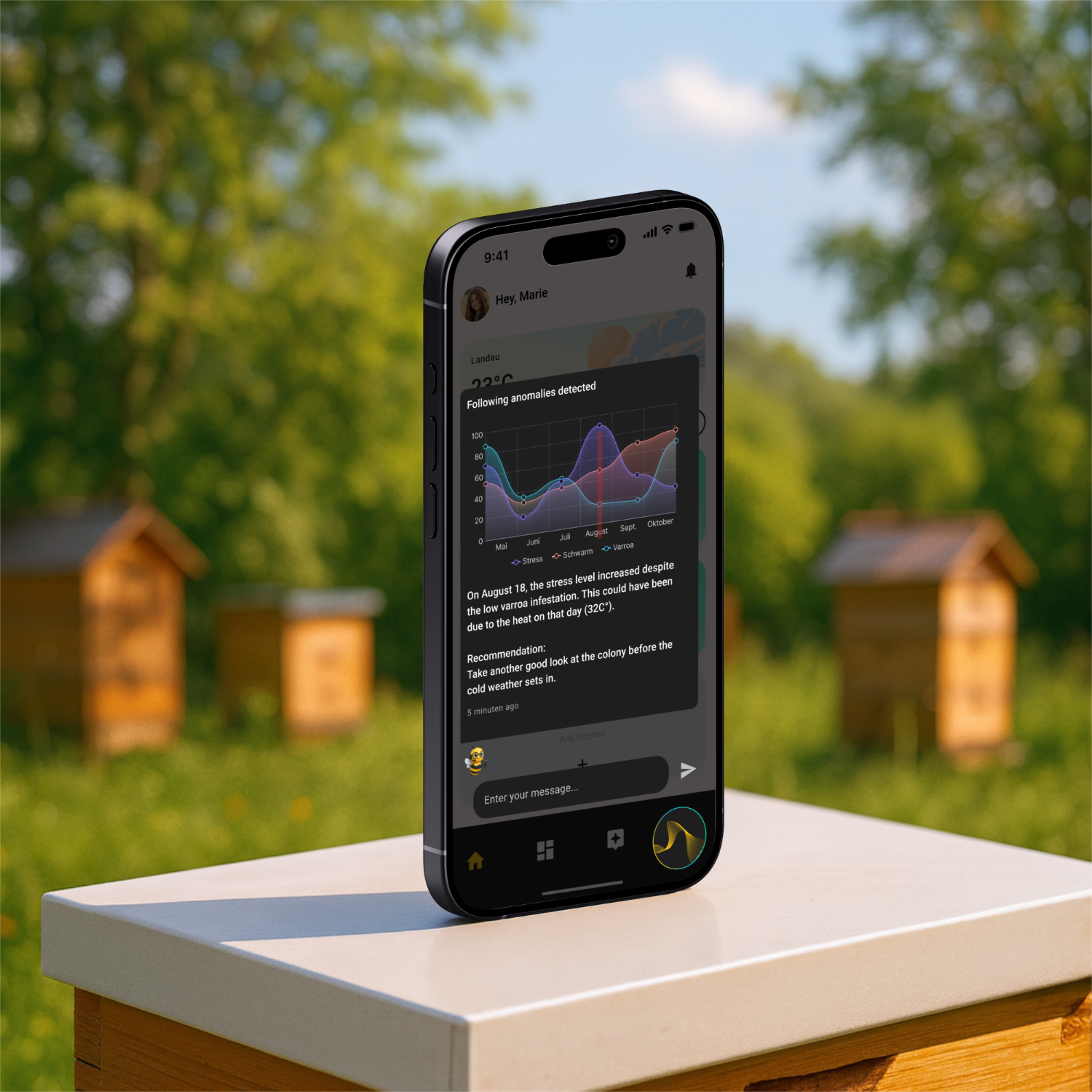
Before we turn to digital solutions, it’s worth looking at the classic challenges that beekeepers face daily:
Working with a bee colony requires full attention and both hands. Between frame inspections, cutting out drone brood, and searching for the queen, there’s hardly time to pick up a pen. Even if there were — gloves, propolis on fingers, and wind make writing a challenge.
Many beekeepers document their observations only after inspecting all colonies. But anyone who can still remember exact details of the first colony after the fifth or tenth inspection is the exception. Important information about brood patterns, food stores, or behavioral anomalies is lost.
Handwritten hive cards vary in their level of detail and structure. Sometimes colony strength is estimated, sometimes counted. Sometimes frame lanes are noted, sometimes not. This inconsistency makes later evaluation difficult and prevents data-driven decisions.
The additional documentation effort leads some beekeepers to postpone or shorten inspections. Especially with larger operations, this can become a risk when swarming mood or diseases are detected too late.
Voice-based hive record management uses modern speech recognition technology to transform spoken observations directly during hive inspection into digital, structured data. The beekeeper simply speaks their observations — the software handles transcription and structuring.
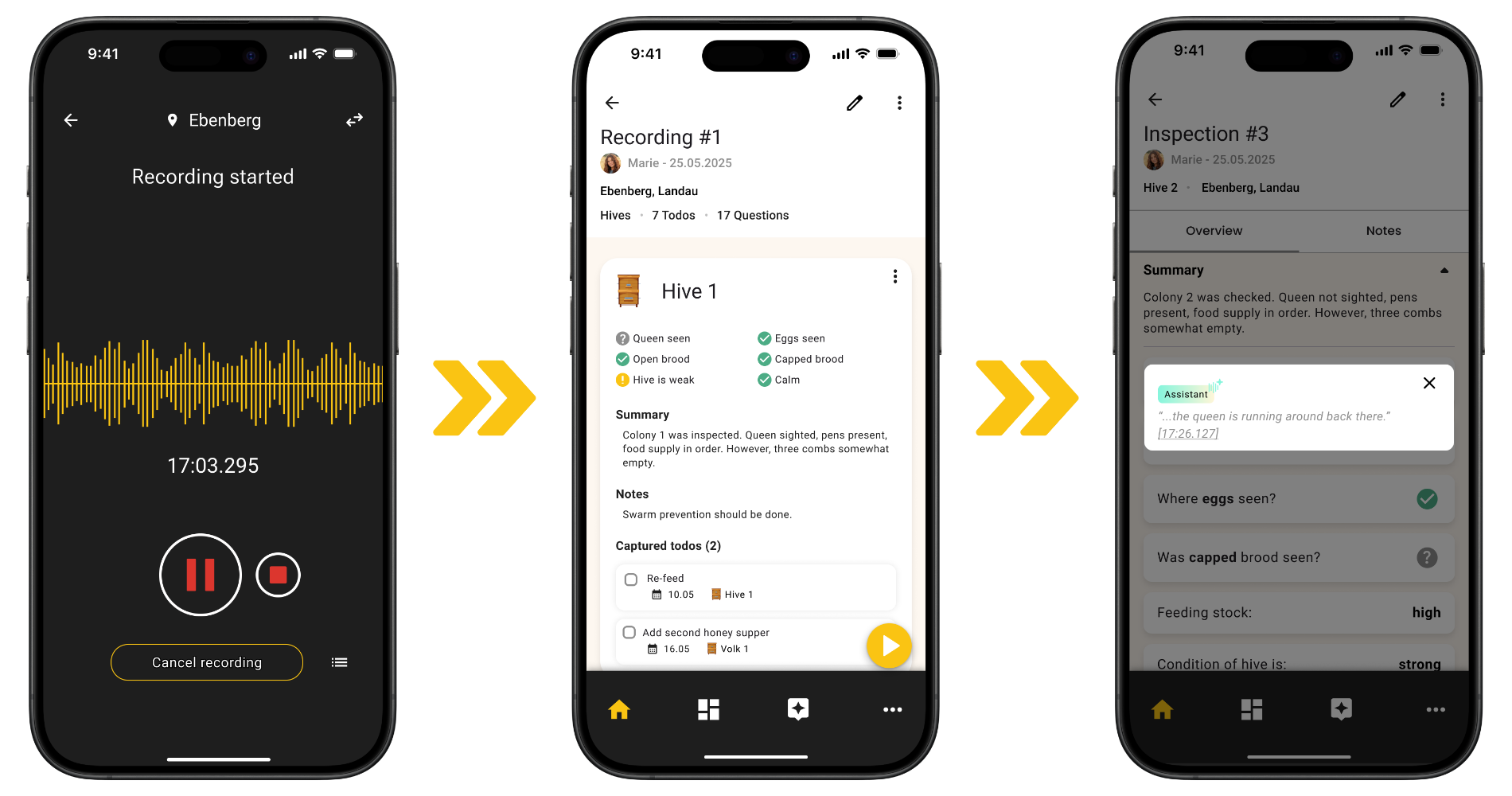
The concept is elegantly simple: instead of pen and paper, the beekeeper uses their smartphone or tablet. During the hive inspection, observations are spoken: “Brood pattern solid, eight frames covered, food stores three kilograms, varroa infestation low.” The app captures this information in real-time and automatically assigns it to the correct categories.
The crucial difference from simple voice notes lies in intelligent processing: modern systems not only recognize the words but also understand their meaning in the context of beekeeping. They distinguish between colony strength, food stores, queen observations, and other parameters. The result: instead of unstructured text notes, structured datasets are created that can be analyzed, compared, and evaluated.
The spoken data is transferred directly to the digital hive card. Historical progressions are automatically built up, developments are graphically displayed, and reminders for upcoming tasks can be created. Documentation thus becomes an integral part of a digital beekeeping management system.
Switching to voice-based hive record management brings numerous advantages that extend far beyond mere time savings:
The most obvious advantage: hands remain free for the actual work. No putting down tools, no searching for pen and paper, no illegible notes with sticky fingers. Documentation occurs parallel to the inspection without interrupting the workflow.
When documentation requires no effort, it’s done more consistently. Voice-based systems promote completeness of records since every observation can be captured immediately. Details that would otherwise be forgotten flow directly into the hive card.
Studies from other industries show that speaking is about three times faster than typing. In beekeeping, where conditions are additionally challenging, this factor is likely even higher. What previously required 15 minutes of post-processing per colony is done in seconds.
Intelligent voice systems can guide the beekeeper through documentation and help ensure important parameters aren’t forgotten. The resulting datasets follow a uniform structure, which considerably facilitates later evaluation and comparison between colonies.
Structured, complete data is the foundation for sound decisions. Development progressions become visible, patterns recognizable, and critical situations can be identified earlier. The digital hive card transforms from a pure documentation instrument to a management tool.
When choosing a solution, the following aspects should be considered:
Development is still in its early stages. Future generations of voice assistants will allow more active interaction in both directions and will gradually transform into comprehensive assistants. The virtual expert for your pocket.
The combination of speech recognition, artificial intelligence, and comprehensive databases will make beekeeping increasingly data-driven — without disrupting the practical workflow.
This is exactly where HIVESOUND comes in. The app was developed specifically for the requirements of modern beekeepers and offers one of the most advanced voice assistants for hive record management on the market.
What’s special: The HIVESOUND voice assistant is not just a simple dictation tool, but understands the context of beekeeping in depth. Spoken observations are transferred with high accuracy into structured datasets — even with complex technical terms and natural language. Whether “brood pattern spotty,” “five frames with drone brood,” or “treated with 3ml oxalic acid” — the system recognizes the meaning and automatically assigns the information.
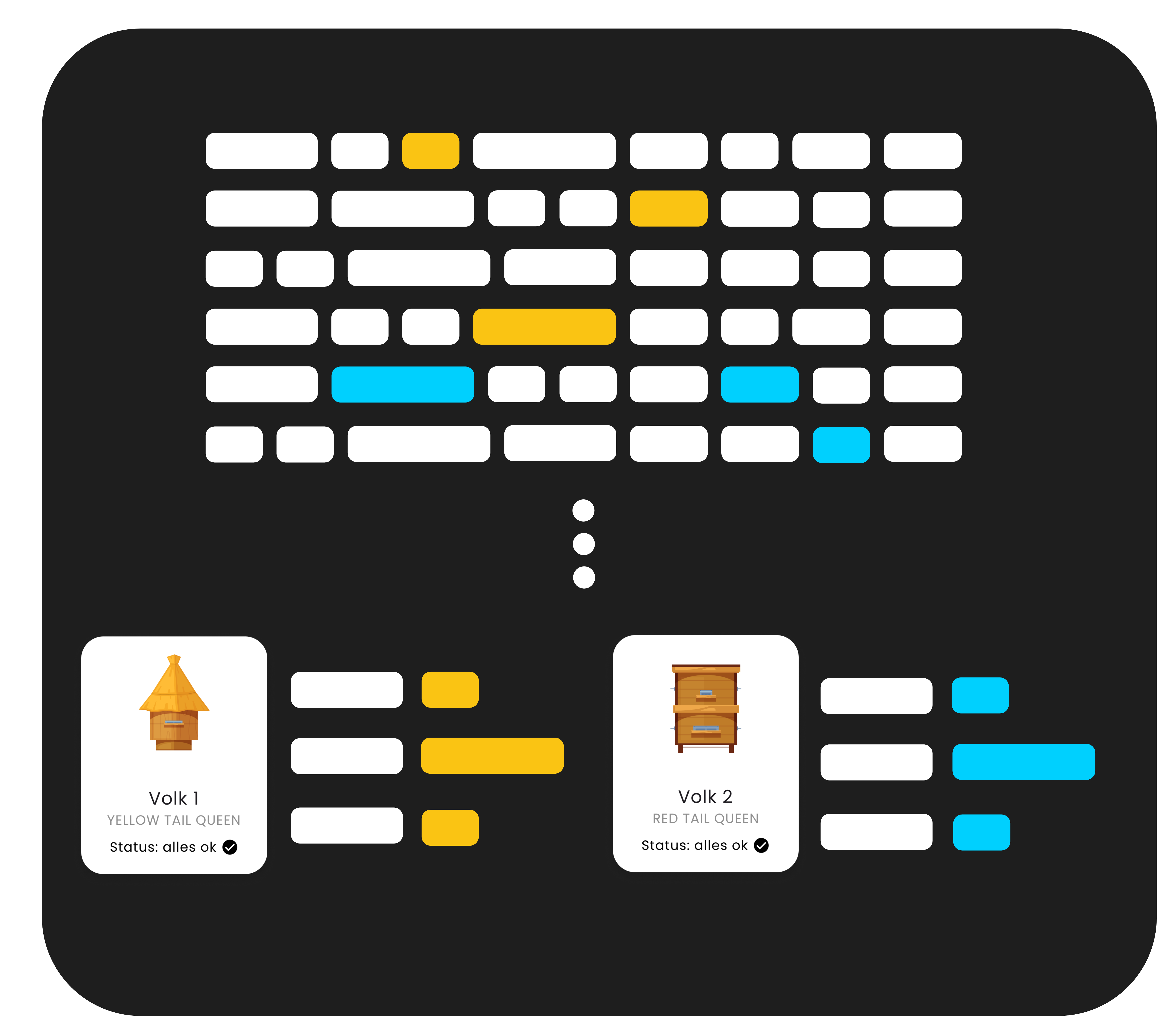
A special advantage of HIVESOUND: beekeepers can discuss all their colonies in one session without stopping the recording or switching between different views. You simply mention the stored name of the respective colony — such as “Colony Emma” or “Colony 2” — and the system automatically assigns all following observations to the correct colony.
This function reflects the natural workflow: going from hive to hive, observing, speaking, moving on to the next. No typing, no searching through menus, no workflow interruption. Especially during larger apiary visits with ten or more colonies, this saves an enormous amount of time.
The HIVESOUND app also works without reception. You can view datasets, create new ones, and also record voice recordings. These are stored locally and as soon as network is available again, they are uploaded and evaluated — naturally GDPR compliant and in Europe!
HIVESOUND goes one step further and automatically recognizes tasks and notes in what’s said. If the beekeeper says, for example, “Need to add honey supers next week” or “Don’t forget to remove swarm cells,” the system automatically creates corresponding todos with reference to the respective colony.
Implicit tasks are also recognized: with “food stores low,” the app generates a feeding reminder. With “varroa infestation high,” a treatment note is automatically created. At the same time, all additional remarks — such as “colony very gentle” or “noticeably many drones” — land as structured notes in the hive card.
As a beekeeper, you can thus concentrate completely on the work and observations. The app not only handles documentation but also thinks along and ensures that no important task is forgotten.
In the upcoming articles of this series, we will present further features of HIVESOUND and show how modern technology facilitates daily work at the hive without displacing proven beekeeping practices.
The HIVESOUND app is also available not only on smartphones but also on the web at app.hivesound.ai, if you want to dive into your records again from the office or from home!
Voice-based hive record management is more than a technical gadget — it’s a genuine work facilitation that helps beekeepers better understand and manage their colonies. Hands remain free, documentation becomes more complete, and the resulting data forms the foundation for sound decisions.
Anyone managing multiple colonies or wanting to professionalize their beekeeping should familiarize themselves with the modern possibilities of speech recognition. The technology is mature, the advantages convincing — and the future of digital beekeeping has only just begun.



@HIVESOUND 2025